


The Australian Bureau of Statistics (ABS) will ask Australians completing next year’s Census to answer a religion question that it criticised and made a compelling case against in a private briefing with the Albanese government, documents obtained under freedom of information laws show.
The Rationalist Society of Australia can reveal that, in a four-page briefing paper to Assistant Minister Andrew Leigh and to Treasurer Jim Chalmers in CC on 3 May 2024, the ABS comprehensively rejected the concerns from religious lobbyists about proposed changes to the question, including to remove the biased wording.
The ABS also told the government that updates to the question were “required” for a number of reasons, including “better reflect the diversity of the Australian community and address concerns regarding quality of data with the existing question”, and to make the structure of the religion question consistent with other questions in the Census.
However, the ABS will re-use the biased wording for the religion question at next year’s Census, set to take place on 11 August 2026. Last month, it released the finalised set of topics and questions for the Census.
In April 2024, days before the ABS sent the briefing paper to Dr Leigh, Catholic bishops and Liberal Party figures had publicly attacked the ABS for “seeking to weaken the accuracy” of the religion question, and warned that changing the question would create a “new bias” in favour of ‘no religion’.
In a media campaign, the Catholic hierarchy publicly called on the Albanese government to intervene in the matter and, as reported in Catholic media, church leaders had written directly to Prime Minister Anthony Albanese.
At that time, following more than two years of public consultation and cognitive testing, the ABS proposed to change the Census religion question from the biased ‘What is the person’s religion?’ to ‘Does the person have a religion?’, with an accompanying text box for religious people to write in their affiliation. The public’s overwhelming feedback to the ABS had called for removal of the bias from the question.
In late May 2024, the ABS released a public clarification to counter the claims being made by religious lobbyists and politicians in media reports.
In the briefing paper to Dr Leigh, the government minister responsible for the Census, the ABS was far more forthright in addressing “inaccuracies” in the media and why it had proposed changes to the question. It said:
The changes being considered and tested by the ABS look to remove the assumption that a person has a religion….
…the ABS is of the view that the question “What is the person’s religion?” contains an assumption that the person has a religion and makes the answer “No religion” grammatically incorrect. The question “Does the person have a religion?” is thought to be a better question with two options for response: “No”, and “Yes” (specify religion)”. Other questions follow this design – for example, the question is “Does the person use a language other than English at home?” not “What language other than English does the person use at home?
Religious lobbyists had raised concerns that the proposed changes would mean the Census result would no longer be comparable with past Censuses and that it would be harder for people to complete, especially those from minority religious groups, as they would have to write their affiliation.
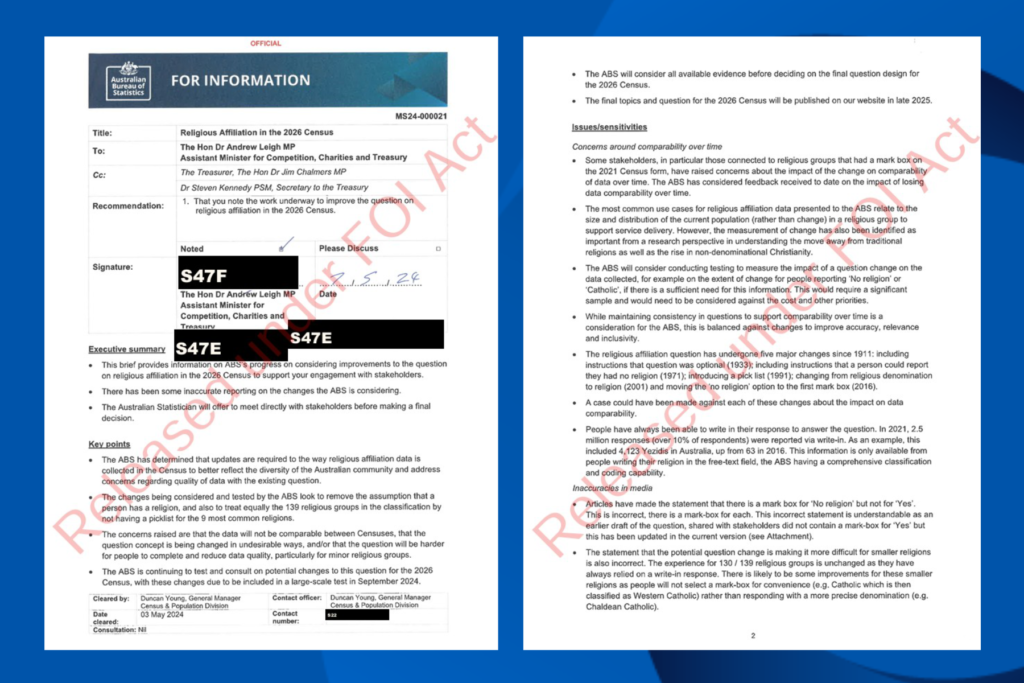

In the briefing paper, the ABS said the desire for maintaining comparability with past Censuses needed to be “balanced against changes to improve accuracy, relevance and inclusivity.” It added:
The religious affiliation question has undergone five major changes since 1911: including instructions that question was optional (1933); including instructions that a person could report they had no religion (1971); introducing a pick list (1991), changing from religious denomination to religion (2001) and moving the ‘no religion’ option to the first mark box (2016).
A case could have been made against each of these changes about the impact on data comparability.
The ABS also rejected the claim that some people would experience difficulty writing their religion in the free text box.
People have always been able to write in their response to answer the question. In 2021, 2.5 million responses (over 10% of respondents) were reported via write-in.
The statement that the inability for people to enter perfect data in a free text box will lead to poor data is not necessarily correct. The Census has many free text boxes and advanced coding processes that successfully classify responses against a classification. This is the process for the majority of religious groups currently.
The ABS has decided to keep the biased question but has made minor changes to the instructional text and the order of the response options (to reflect the most commonly reported religions in the 2021 Census). The continued use of the flawed question means that governments, policy-makers, researchers and the wider community will still not be able to access any accurate Census data on the religious and non-religious affiliation of Australians.
Even with the biased question inflating the religion result, ‘no religion’ is on track to overtake Christianity at the 2026 Census.
In a letter to the RSA in September this year, the head of the ABS, David Gruen (pictured), rejected concerns that the continued use of the biased religion question was discriminatory and in breach of the country’s international human rights commitments.
“…the current question design was chosen after extensive rounds of consultation with stakeholders and testing. It gives non-religious Australians full opportunity to record that they have no religion,” said Dr Gruen.
Note from editor: Edits have been made to enhance clarity (5 December 2025).
See all of the RSA’s reporting about the Census question here.
If you want to support our work, please make a donation or become a member.
Si Gladman is Executive Director of the Rationalist Society of Australia. He also hosts ‘The Secular Agenda’ podcast.
Image: Australian Bureau of Statistics